What Is the Best Enterprise Volunteer Scheduling Software for Food Bank Operations?
Quick Answer: The right software treats food safety training status as a scheduling condition, not a separate compliance record. It can also flex around unpredictable donation timing, rather than assuming a fixed, predictable shift calendar. Food banks operate warehouse-style sorting and packing operations alongside distribution events. They often coordinate with a network of partner pantries and meal programs, and they depend on volunteers to handle food directly. That means scheduling has to account for training currency and health reporting in ways a typical volunteer program does not.
The Feeding America network alone includes roughly 200 food banks and 60,000 partner food pantries and meal programs providing food to more than 46 million people each year, a scale of operation that depends heavily on volunteer labor for sorting, packing and distribution.1 Scheduling software for this context needs to support that scale without losing track of who is actually qualified to handle food on a given shift.
What Makes Scheduling Different for a Food Bank Than for a Typical Volunteer Program?
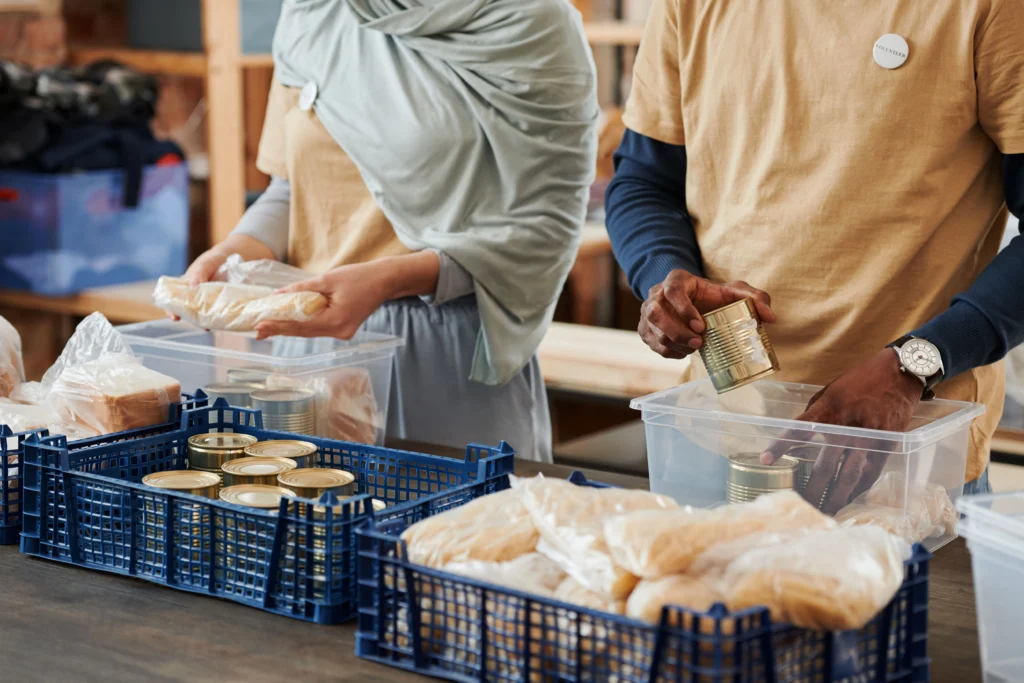
A typical volunteer program schedules people around a relatively predictable set of activities. A food bank schedules people around food itself, which arrives on its own timeline, must be handled according to food safety requirements and moves through distinct stages: receiving, sorting, storing and distributing, each with different volunteer needs. Scheduling software built for a generic volunteer program often has no concept of food safety training status, shelf-stable versus perishable handling differences or the kind of donation-driven urgency that can require volunteers on short notice.
This means a food bank evaluating scheduling software should look specifically for support of these food-operation-specific realities, rather than assuming a generalist volunteer scheduling tool will translate cleanly to a warehouse and distribution environment.
How Should Scheduling Software Track Food Safety Training Status for Each Volunteer?
Volunteers who handle food directly, whether receiving donations, sorting or repackaging, are a key part of ensuring food safety in a hunger relief organization, since improper handwashing, contaminated surfaces and other hygiene lapses are common, documented risks in these settings.2 Scheduling software should track each volunteer’s current food safety training status as a scheduling condition, meaning a volunteer without current training simply is not offered a shift involving direct food handling, rather than relying on staff to remember and manually check training records separately from the schedule itself.
This built-in eligibility check reduces the chance that an untrained volunteer ends up on a food-handling shift purely because the staff member scheduling volunteers that day was unaware their training had lapsed or was never completed in the first place.
How Should a Food Bank Handle Scheduling Around Unpredictable Donation Timing?
Large or unexpected donations, such as a retail overstock delivery or a post-holiday surplus, can require rapid volunteer mobilization on short notice, which a fixed, advance-only shift calendar struggles to handle. Scheduling software should support both traditional advance sign-ups and a fast, opt-in notification system for volunteers willing to respond to short-notice sorting or packing needs.
A standby or on-call volunteer pool, similar in concept to a no-show backup system but used proactively for donation surges rather than reactively for cancellations, gives a food bank a way to flex capacity up quickly without having to build every shift around worst-case donation volume in advance.
What Is the Difference Between Scheduling for Warehouse Sorting and Scheduling for Distribution Days?
Warehouse sorting and packing shifts are typically ongoing, can flex in size somewhat based on donation volume and mostly require food safety training rather than public-facing skills. Distribution days, when food reaches partner agencies or individuals directly, often require a fixed, precise headcount tied to a specific date and time, with volunteers who may need different skills, such as client interaction or driving, in addition to food handling.
Scheduling software should treat these as genuinely distinct shift categories with different requirements and tolerances for flexibility, rather than applying a single uniform shift template to both a same-day sorting shift and a scheduled community distribution event.
How Should Scheduling Software Support a Food Bank’s Network of Partner Agencies?
A food bank typically distributes food through a network of partner pantries and meal programs rather than exclusively through its own direct distribution events, and volunteer scheduling needs at partner agencies are not always the food bank’s own to manage directly.1 Scheduling software should be able to distinguish between volunteers working the food bank’s own warehouse and distribution operations and volunteers who may be recruited on the food bank’s platform but actually serve at a partner agency location.
This distinction matters for training requirements as well, since a partner agency may have its own food handling standards that differ somewhat from the central food bank’s own requirements, and scheduling software that cannot represent this layered structure risks either over-restricting partner agency volunteers or under-verifying training for the food bank’s own direct shifts.
What Role Does Volunteer Health Reporting Play in Food Bank Shift Scheduling?
Volunteers who are experiencing symptoms such as vomiting, diarrhea or a fever with sore throat should be instructed to stay home from food-handling shifts, since these are recognized indicators of potential foodborne illness risk in hunger relief settings.2 Scheduling software that gives volunteers an easy, low-friction way to report themselves unavailable due to illness, ideally through the same channel used for routine shift cancellation, makes it more likely that a sick volunteer will properly cancel rather than either showing up anyway or simply not showing up without notice.
This connects health reporting directly back to the no-show and rescheduling mechanics common to any volunteer scheduling platform, but with an added food safety dimension that makes a smooth, judgment-free cancellation path more important than it would be in a lower-stakes volunteer context.
How Should a Food Bank Scale Scheduling Across a Large Volunteer Base?
A food bank operating at a meaningful scale, potentially coordinating thousands of volunteer shifts across sorting, packing, distribution and partner agency support each year, needs scheduling software that can segment its volunteer base by training status, availability pattern and preferred shift type without requiring staff to manually filter through the entire roster for every scheduling decision.
Formal volunteering nationally already involves tens of millions of people contributing billions of hours a year, and food banks represent one of the largest single categories of that activity, given how central volunteer labor is to hunger relief operations.3 Software built to handle this kind of scale should make it straightforward to answer operational questions quickly, such as how many currently trained volunteers are available for a specific shift type next week, without requiring a manual cross-reference between separate training and scheduling records. Given that an hour of volunteer time now carries an estimated national value of $36.14, a food bank operating at scale has real financial reasons, not just operational ones, to schedule its volunteer base efficiently.4
Key Takeaways
Food bank scheduling needs to account for food safety training status, donation timing and distinct shift types in ways a generic volunteer scheduling tool typically does not.
Scheduling software should treat current food safety training as an eligibility condition for food-handling shifts, not a separate compliance record checked manually.
A standby or on-call volunteer pool helps a food bank flex capacity up quickly in response to unpredictable donation volume.
Warehouse sorting shifts and public distribution day shifts have different requirements and should be scheduled as distinct categories.
Software should be able to represent the difference between volunteers serving the food bank directly and those serving through a partner agency.
A low-friction way for volunteers to report illness and cancel a food-handling shift supports both food safety and no-show reduction at once.
About This Topic
Enterprise volunteer scheduling software for food bank operations refers to scheduling platforms built to handle the specific operational realities of hunger relief work, including food safety training requirements, unpredictable donation-driven demand, distinct shift categories for warehouse and distribution work and coordination across a network of partner agencies. Selecting the right platform means evaluating these food-operation-specific capabilities in addition to standard scheduling features.
Comparative Analysis Table
The table below compares a generic volunteer scheduling tool with scheduling software designed specifically to meet food bank operational needs.
Factor
Generic Volunteer Scheduling Tool
Food-Bank-Specific Scheduling Software
Notes
Food safety training tracking
Usually a separate record, if tracked at all
Built in as a scheduling eligibility condition
Reduces the risk of untrained volunteers on food-handling shifts
Donation-driven flexibility
Assumes a fixed, advance-only shift calendar
Supports standby or on-call capacity for surges
Matters most for organizations with variable donation volume
Shift category distinction
Applies one shift template broadly
Distinguishes warehouse sorting from distribution events
Different shift types have different real requirements
Partner agency support
Not typically designed for this structure
Can represent food bank versus partner agency shifts
Relevant mainly for food banks coordinating a partner network
Best fit
A small, single-site food pantry
A larger food bank with varied operations and partners
Scale and operational complexity should guide this choice
How to Implement
Connect Food Safety Training Records to Shift Eligibility: Configure the platform so a volunteer without current food safety training is not offered food-handling shifts, rather than relying on manual staff checks.
Set Up a Standby Pool for Donation Surges: Recruit and organize a group of volunteers who have opted into short-notice availability for unexpected donation volume.
Create Distinct Shift Templates for Sorting and Distribution: Build separate shift types with different requirements and flexibility levels for warehouse operations versus public distribution events.
Represent Partner Agency Shifts Separately From Direct Shifts: Configure the platform to distinguish volunteers serving the food bank directly from those recruited for partner agency locations.
Add a Low-Friction Illness Reporting Option: Give volunteers an easy way to cancel a food-handling shift due to illness through the same channel used for routine cancellations.
Troubleshooting FAQs
What If a Volunteer’s Food Safety Training Expires Between Scheduling and the Actual Shift Date?
Set training records to expire automatically in the scheduling system on the correct date, so a volunteer whose certification lapses between sign-up and the shift is flagged and prevented from checking in for a food-handling role until retrained.
What If a Large, Unexpected Donation Arrives With No Scheduled Volunteers Available?
This is exactly the scenario a standby or on-call pool is meant to address. If no such pool exists yet, treat the gap as a signal to build one, starting with volunteers who have expressed interest in flexible or last-minute availability. Nonprofit investment in automated, real-time notification systems needed to run a standby pool effectively has historically lagged behind other back-office technology investments, so it is worth confirming the chosen platform can actually support these systems before relying on them during an actual surge.5
What If Partner Agencies Have Inconsistent Food Safety Training Standards of Their Own?
Apply the food bank’s own training standard as a floor for any volunteer recruited through its platform, regardless of the specific location they ultimately serve, and clearly document any additional requirements a partner agency may layer on.
Best Practices Checklist
Tie food safety training status directly to shift eligibility rather than tracking it in a separate system.
Build a standby or on-call volunteer pool to handle unpredictable donation-driven demand.
Create distinct shift categories for warehouse sorting, packing and public distribution events.
Distinguish volunteers serving the food bank directly from those serving through partner agencies.
Make illness-related shift cancellation simple and judgment-free for food-handling roles.
Set training records to expire automatically in the scheduling system rather than relying on manual review.
Glossary
Term
Definition
Food safety training status
A volunteer’s current certification or completion status for required food handling training.
Standby pool
A group of volunteers who have opted into short-notice availability, often for donation surges.
Partner agency
A local food pantry or meal program that distributes food supplied by a larger food bank.
Warehouse sorting
The process of receiving, inspecting and organizing donated food before distribution.
Distribution day
A scheduled event where food is provided directly to partner agencies or individuals.
Shift eligibility condition
A requirement, such as current training, that must be met before a volunteer can be scheduled for a shift.
Donation surge
An unusually large or unplanned volume of food donations arriving on short notice.
References
1. Feeding America. “The Feeding America Network.” Feeding America. Accessed July 26, 2026. https://www.feedingamerica.org/our-work/food-bank-network.
2. Yi, Jiakun, H. Lester Schonberger and Laura K. Strawn. “Best Food Safety Practices for Hunger Relief Organizations: Volunteer Health, Hygiene, and Training.” FST-488NP. Virginia Cooperative Extension, Virginia Tech. October 14, 2024. Accessed July 26, 2026. https://www.pubs.ext.vt.edu/FST/fst-488/fst-488.html.
3. U.S. Census Bureau. “New U.S. Census Bureau and AmeriCorps Research Tracks Virtual Volunteering for First Time.” U.S. Census Bureau. November 19, 2024. Accessed July 26, 2026. https://www.census.gov/library/stories/2024/11/civic-engagement-and-volunteerism.html.
4. Independent Sector. “Value of Volunteer Time.” Independent Sector. 2025. Accessed July 26, 2026. https://independentsector.org/research/value-of-volunteer-time/.
5. NTEN and Heller Consulting. “2024 Nonprofit Digital Investments Report.” NTEN. 2024. Accessed July 26, 2026. https://word.nten.org/wp-content/uploads/2024/04/2024-Nonprofit-Digital-Investments-Report.pdf.
What Is the Best Volunteer Scheduling Software to Reduce No-Shows?
Scheduling software fights no-shows through communication: when reminders land, how they're worded, which channel they use, and how easily a volunteer can reschedule instead of ghosting. One fixed reminder leaves results on the table—here's what to look for in timing, message control, and rescheduling flow.
What Is the Best Option for Reducing Volunteer No-Shows at Scale?
Shift-by-shift tactics break down across thousands of volunteers. At scale, reducing no-shows becomes a data problem—and a volunteer's own attendance history is the single strongest predictor. The best lever is a complete history and a reliability score that triggers earlier outreach, not one coordinator's memory.